What's different in the UK
Two things set the UK apart. First, there's no single national register of where you live, the way many European countries have. Your address simply surfaces wherever you use it: your bank, HMRC, the electoral roll, your council tax.
Second, and importantly: in the UK a TDPB address is for individuals and for sole traders trading in their own name. It can't be used by or for a limited company or any other legal entity. More on both below.
How to write your UK address
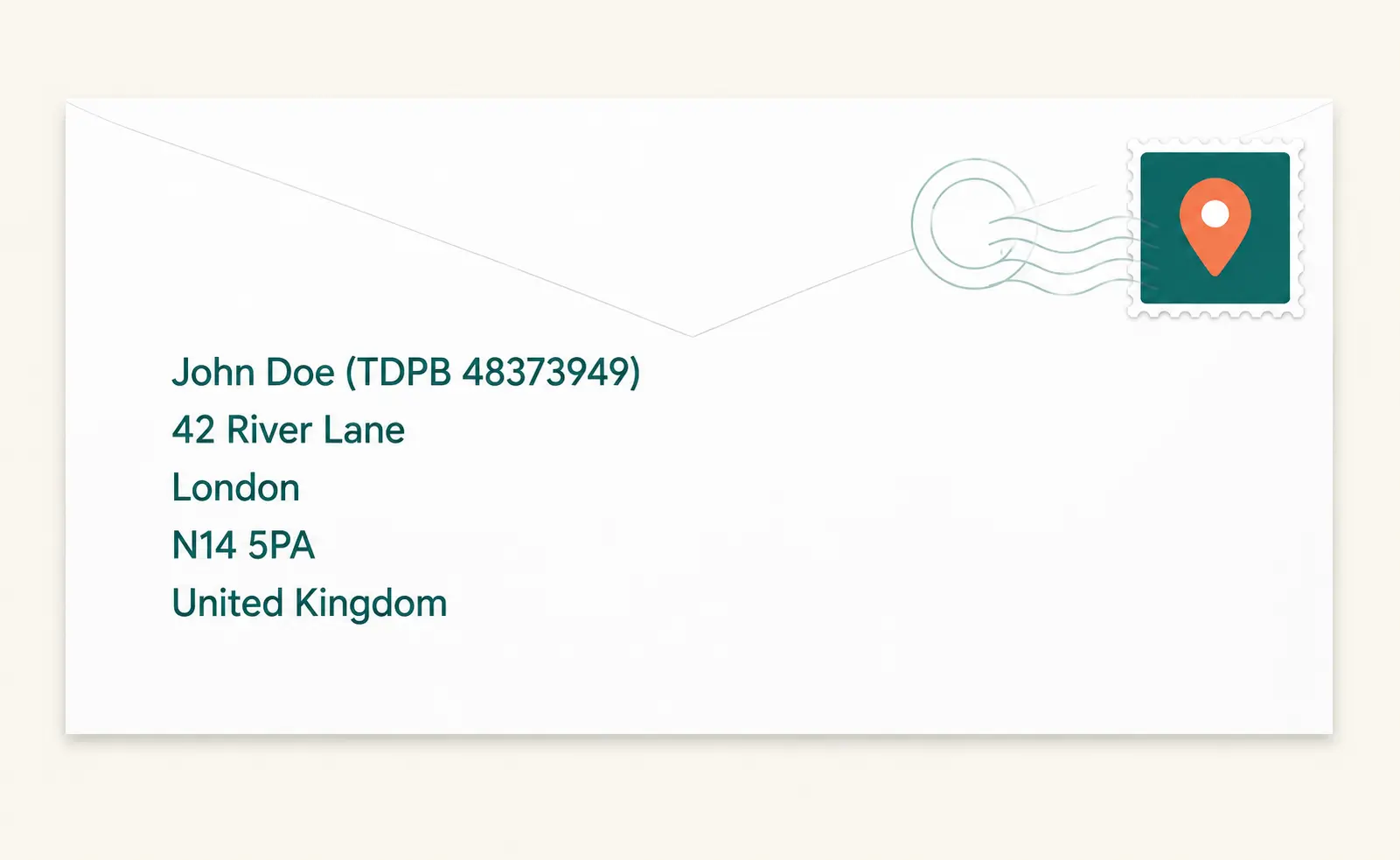
When you receive your UK address, use it exactly as we provide it, including your TDPB number. That number is unique to you, and it's what tells us the mail at that location is yours. You can add it after your name or on a separate address line. Adding it every time is what makes sure your post is assigned to you quickly and reliably, so always keep it in place when you give out your address.
Where you can use your address in the UK
Banks and financial institutions
Many customers use their TDPB address with UK and international banks for statements, cards and account correspondence. One UK-specific thing to know: when you open a new account, a bank often asks for proof of address, a document showing where you actually live, such as a utility bill or council tax statement. A correspondence address isn't proof of residence, so it may not satisfy that particular step. For ongoing correspondence with a bank that already has you on file, it works well. Acceptance is always the bank's own call, but our model, real Partner locations used by a limited number of people rather than a mass virtual-office hub, is built to avoid the patterns banks tend to flag.
HMRC, taxes and correspondence
If you've moved abroad or live between countries, HMRC and other bodies may still need to reach you by post, about your tax, a pension, or past UK affairs. A TDPB address gives them a stable place to send that correspondence.
What it isn't: a way to establish or change your tax residence. Where you're tax resident is determined by your actual circumstances, not by a postal address, and a TDPB address can't be used as proof of tax residence or fiscal establishment. Our Terms set this out: the address is for receiving and handling correspondence, not for any tax-domicile purpose. If your situation needs a UK address tied to where you live, that's a matter for an accountant, not a correspondence address.

Registering a company or registered office
This is where the UK works differently from most of our other countries. A TDPB address in the UK is for individuals and for sole traders trading in their own name. It can't be used by or on behalf of a separate legal entity, such as a Ltd, Limited or LLP, not even as a correspondence address. Mail addressed to a company name may be refused or returned. So a UK address can't serve as a registered office or company address, and it isn't suitable if you trade through a limited company. If you're a sole trader in your own name, you're free to use it for your business correspondence, invoices and website. If you run a limited company, you'll need a dedicated registered-office and company-address provider for that.
Residence, the electoral roll and council tax
The UK has no central residence register, but several things are still tied to where you actually live: registering to vote on the electoral roll, council tax, registering with a GP, and "proof of address" for many everyday services. A TDPB address is a correspondence address, not a residential one, so it can't be used for any of these. For anything that depends on where you genuinely live, you'll need your residential address.
Invoices, website and email signature
If you're an individual or a sole trader trading in your own name, yes. A TDPB address gives you a professional UK address for your invoices, website and email signature, without putting your home address on everything. The one limit follows from the above: it can't be used for a limited company, and it isn't a legal business-registration address.
What a TDPB address is, and isn't
To keep expectations clear: a TDPB address is a stable correspondence address. It is not a residential address, not a tax or fiscal address, not a registered office or legal seat, and not a walk-in business location. That narrower scope is deliberate. It's what lets the address stay usable almost everywhere while everything else around you changes. For the full picture of how our addresses work and why, see our main using your address page.
About acceptance
Whether any specific bank, authority or institution accepts any specific address is always their decision. Rules differ by country and situation, and they can change over time. We don't promise acceptance, because we don't control it. What we do control is how the model is built: real Partner locations, used by a limited number of customers, on ISO 27001 and ISO 27701 certified processes, with full transparency about what the address is and isn't.