What’s different in the Netherlands
The Netherlands works a little differently from most of our other countries. Here, a TDPB address is a personal correspondence address: used under your own name, and only your own name. Mail addressed to a business or trading name isn’t accepted and may be returned to sender. Dutch post itself is simple - delivered to the address by name - but that name needs to be you. Two official registers also sit outside what the address does: where you live (the Basisregistratie Personen, or BRP, at your municipality) and where a business is registered (the Kamer van Koophandel, or KvK). A TDPB address isn’t a registration in either.
How to write your Dutch address
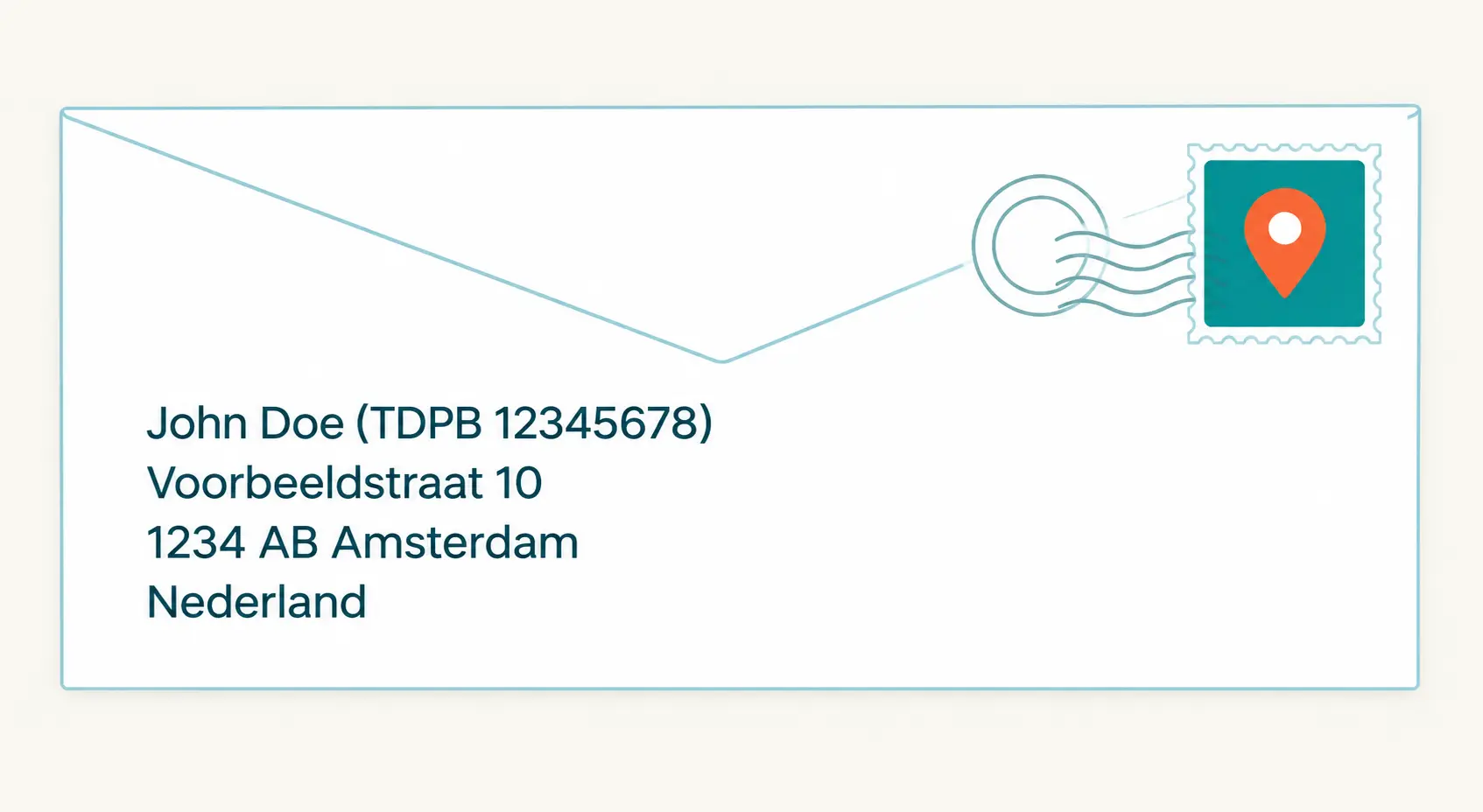
When you receive your Dutch address, use it exactly as we provide it, including your TDPB number. That number is unique to you, and it’s what we use to sort your post and assign it to you. You can add it right after your name or on a separate address line. Dutch post is delivered straight to the address, so the address as we provide it, with your TDPB number, is all you need. Keep the number in place every time you give out the address, and your post is recognised and handled for you.
Where you can use your address in the Netherlands
A personal address, in your own name
In the Netherlands, a TDPB address is a personal correspondence address. It’s used under your own name, so letters addressed to you arrive and are handled as usual. You are also welcome to add other personal names as recipients, for example those of your partner or children. Mail addressed to a business or trading name isn’t accepted and may be returned to sender. You’re very welcome as a private individual, just under personal names, not a company or trading name.
Banks and financial institutions
Many customers use their TDPB address with Dutch and international banks for statements, cards and account correspondence in their own name. Our model - real Partner locations used by a limited number of people, not a mass virtual-office hub - is built to avoid the patterns banks tend to flag. Opening a new account usually involves verifying where you actually live, which a correspondence address can’t provide, so check your bank’s requirements for that step. For ongoing correspondence, it works well. Acceptance is always the bank’s own call.
Your taxes and the Belastingdienst
If you’ve moved abroad or split your time between countries, the Belastingdienst and other bodies may still need to reach you by post. A TDPB address gives them a stable place to send that correspondence, in your own name. What it isn’t: a way to establish or change your tax residence. Where you’re tax resident follows your actual circumstances, not a postal address, and a TDPB address can’t be used as proof of tax residence or fiscal establishment. Our Terms set this out: the address is for receiving and handling correspondence, not for any tax-domicile purpose.
Residence registration (BRP)
Registering where you live in the Basisregistratie Personen (BRP) at your municipality requires a residential address where you actually live. A TDPB address is a correspondence address, not a residential one, so it can’t be used for your BRP registration or anything else that requires proof of residence. For that, you’ll need the address where you genuinely live.
Registering a business and the KvK
A TDPB address can’t be used as your registered address with the Kamer van Koophandel (KvK), as a business address or a postal address. The KvK asks for proof in the form of a huurovereenkomst postadres - a postal-address rental agreement - which we don’t provide, and the KvK is currently tightening the rules around these agreements. Together with the personal-name rule above, this means a Dutch TDPB address is for your private correspondence, not for business registration or business-name mail.
What a TDPB address is, and isn’t
To keep expectations clear: a TDPB address is a stable correspondence address. It is not a residential address, not a tax or fiscal address, not a registered office or legal seat, and not a walk-in business location. That narrower scope is deliberate. It’s what lets the address stay usable almost everywhere while everything else around you changes. For the full picture of how our addresses work and why, see our main using your address page.
About acceptance
Whether any specific bank, authority or institution accepts any specific address is always their decision. Rules differ by country and situation, and they can change over time. We don’t promise acceptance, because we don’t control it. What we do control is how the model is built: real Partner locations, used by a limited number of customers, on ISO 27001 and ISO 27701 certified processes, with full transparency about what the address is and isn’t.