Why your address matters more than your mail
Postal mail volume has been falling for two decades. Most adults receive a fraction of the letters their parents received. The conclusion most people draw is that addresses matter less now. That conclusion is wrong, and the rest of this piece is about why.
Quick Verdict
The paradox
Here is the paradox at the heart of the modern address question: the less mail you receive, the more each piece matters.
When everyone received twenty letters a week, missing one was statistically irrelevant. The bank statement came monthly; the tax notice came annually; the insurance renewal came once a year. If one slipped through, the next one followed.
Today, you might receive a handful of physical letters a year, most of which are junk. The fifth is your tax assessment, your bank's KYC verification request, your insurer's renewal terms, a government notice or a compliance demand from a financial institution. The fifth letter is not noise; it is signal. Missing it has consequences that didn't exist in the previous twenty-letter era.
The reason: most non-critical communication has moved to email and apps. What remains in paper form is the residue of importance. Legal notices, regulatory demands, formal verifications. The post that arrives today is the post that institutions decided was important enough to commit to paper.

What "address" actually means now
Most people still think of an address as a physical destination. That's increasingly only half the story.
In modern administrative systems, an address is:
A verification signal. Banks, brokers and platforms cross-check addresses against shared compliance databases. The address is a data point in your customer profile, used in KYC verification and risk classification.
A reachability point. When something important needs a physical signature, a verification letter, or a card delivery, the address is where it happens. The shift to digital has not eliminated this; it has consolidated it into a smaller number of higher-stakes interactions.
An institutional identifier. Your bank, your insurer and your government bodies hold the address as part of your record. Changing it is a notification event. Forgetting to change it is also an event, but one that surfaces later, when something tries to reach you and cannot.
Mail is one outcome of this address infrastructure. It is not the infrastructure itself.
What most services get wrong
The dominant model in the virtual mailbox category treats the address as a feature of a mail-handling product. The marketing leads with "we scan your mail," "we forward your mail," "we store your mail." The address is presented as a delivery point for the scanning.
This reverses the priority. For most users, the value is not the scanning. It is the address itself. The scanning, the forwarding, the notifications: these are operational tasks that matter when mail actually arrives, which is rarely. The address matters every day, because it is the institutional reference your accounts, your records and your compliance position rest on.
Treating the service as mail-first creates several problems:
Pricing is structured around mail volume. Bundled subscriptions can get expensive once features and limits add up. If you receive almost no mail, you are paying for an infrastructure designed around something you do not have.
The address is positioned as commercial. Mail-handling services are often classified as commercial mail-receiving agencies, and some banks flag the address as a result.
The product evaporates if mail volume goes to zero. Email migration continues. If mail volume keeps falling, a mail-handling service eventually has nothing to handle. An address service still has the address.
The address-first model
TDPB is built around a different model. The product is the address. Mail handling is secondary and optional.
What this means in practice:
You pay for the address itself. From € 7,50/month on the yearly plan, or € 15/month on the monthly plan, it covers the address regardless of how much mail arrives.
Mail handling is a separate, optional layer. Pay-per-scan at € 0,90 per scan for users with low volumes. Unlimited scanning at € 7,50/month per address for users who want flat-fee predictability. Full service at [pricing_full_service]/month per address for users who want forwarding included.
The address is real. Real Partner locations in Spain, Germany, Switzerland, Belgium, Portugal, France and the United Kingdom; in Dubai, a PO Box with a real location reference (as of May 2026). Austria, Ireland, Cyprus and the Netherlands are next on the expansion list. Each address is managed directly by TDPB and a local Partner.
The address stays consistent. It does not change when you move, when you travel, when your residential situation shifts. The institutional record stays clean.
The address is treated as a real correspondence address. A real Partner address is structurally different from a commercial mailbox: the compliance databases that flag virtual mailbox addresses generally do not flag a directly-managed Partner location. Always verify the specific requirements of the institution you are dealing to be 100% sure.
Why this matters for modern life
Several life patterns expose the address-first principle most clearly.
Expats and second-home owners. Most are not physically present at their address year-round. Mail volume is low. But the address still has to work: banks need to reach them, insurers need to renew them, tax authorities need to assess them. A stable correspondence address handles the reachability without depending on physical presence.
Digital nomads. No fixed residence. Mail volume could be zero in any given year. But banks, brokers and platforms still need an address on file. A real, stable address solves the institutional record problem without claiming a residency that does not exist.
Cross-border professionals. Living in one country, working with clients in another, banking in a third. Each jurisdiction has its own address-on-file expectations. Multiple TDPB addresses under one Digital PO Box number means each institutional record can have an address that matches its expectations, without the user maintaining multiple physical residences.
Privacy-conscious individuals. Want their home address out of institutional records. The address is the privacy surface. A correspondence address that handles the institutional layer keeps the residential address private.
Paperless-minded people. Want as little physical mail as possible. The address still has to exist for the rare letter that does arrive, but mail handling is a thin layer (often just notifications and digital scans) rather than a primary workload.
Across all of these patterns, the unifying logic is the same: the address is the durable need. The mail handling is the occasional consequence.
The phone number analogy
Consider phone numbers. A phone number has value because you can be reached at it. The value does not depend on how many calls you actually receive. A person who receives one call a year still needs a working phone number for that one call. A business that takes 100 calls a day needs the same kind of phone number.
The phone number is infrastructure. Calls are events that happen on the infrastructure. Nobody would argue that a phone number's value depends on call volume.
Address is the same. The address is infrastructure. Mail is events that happen on the infrastructure. Mail volume does not determine address value; institutional reachability does.
What this suggests about pricing
If the address is the product, the address should be the pricing anchor. Mail handling can be priced separately, scaled to actual usage, and added or removed without changing the address itself.
This is why TDPB pricing has the structure it does:
A user who receives almost no mail pays only the base fee in most months. A user with heavier mail volume picks the tier that matches. The address itself does not change. The reachability layer is preserved regardless of which tier sits on top.
How TDPB works in practice
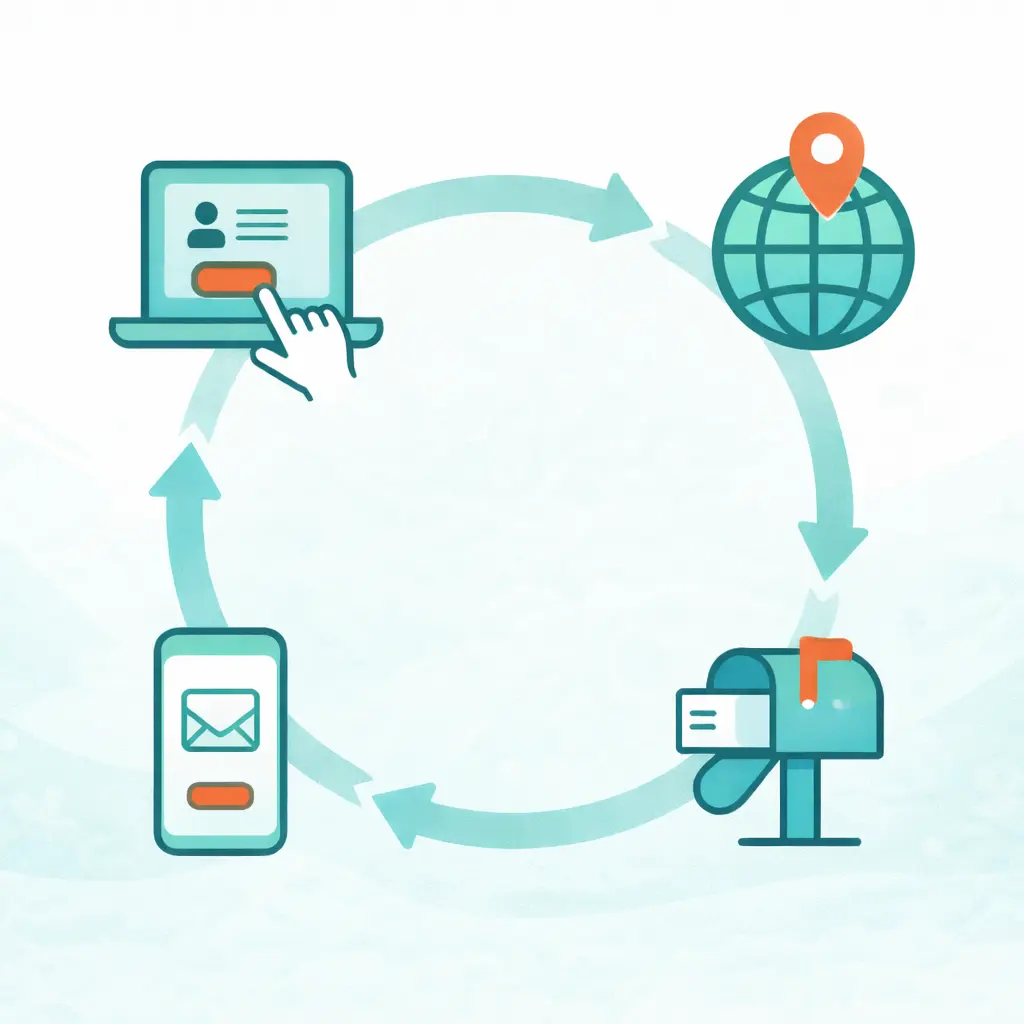
Sign up. Pick a Partner location (or several). Use the address with your banks, brokers, insurers, tax advisers, government bodies, your website and invoices. Mail surfaces in your online inbox as it arrives.
TDPB Partner locations as of May 2026: Spain, Germany, Switzerland, Belgium, Portugal, France and the United Kingdom; Dubai is offered as a PO Box with a real location reference. Austria, Cyprus, Ireland and the Netherlands are next on the expansion list. Multiple addresses can be held under one Digital PO Box number.
Best for: Expats, digital nomads, remote workers, freelancers, second-home owners and privacy-conscious individuals who need a stable address for institutional records, regardless of mail volume.
Get your Digital PO Box in a minute and stop paying for mail you don't receive
Pick a Partner location, sign up, and start using the address with your institutions.