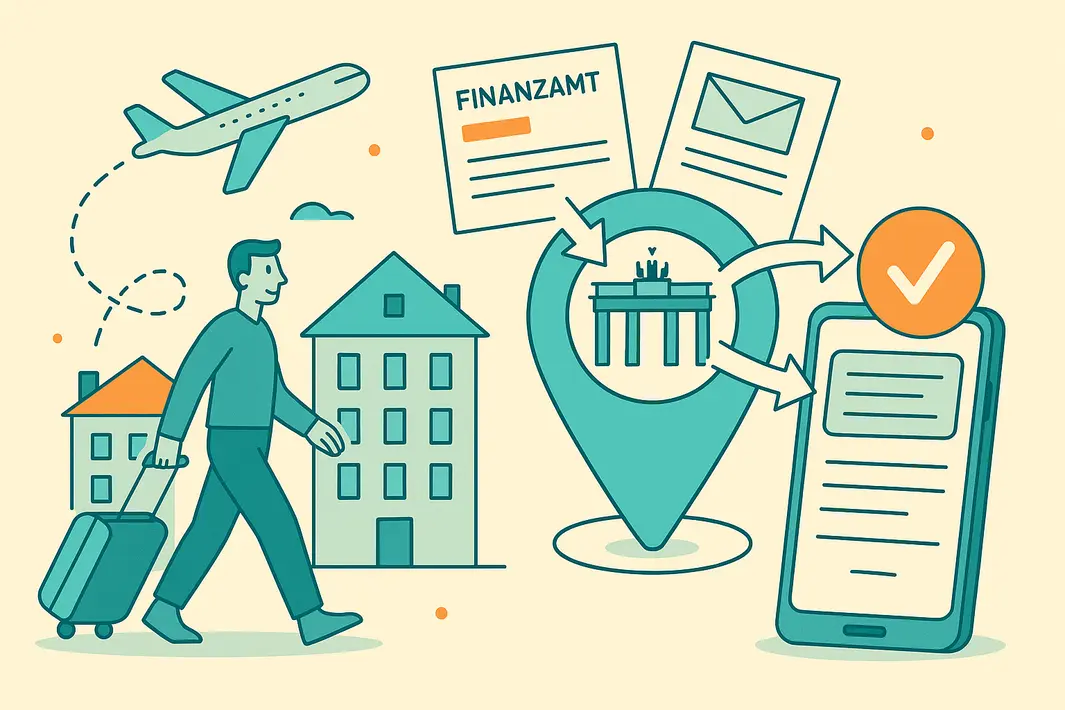
How mail works in Germany
Germany has reliable residential mail delivery through Deutsche Post. Letters arrive at a registered street address (Briefkastenadresse), and most administrative correspondence still uses physical post: Finanzamt notices, bank statements, insurance renewals, pension statements, registry letters, and SCHUFA-related documents.
A few specifics matter for expats:
For expats who leave Germany or move frequently within it, this creates a recurring problem: the address on file at your bank, your Finanzamt, your insurer, and your previous employer all need to be kept current. Deutsche Post forwarding handles this temporarily. After that, you need a stable correspondence address.

The Anmeldung: what it is and what it does not cover
The Anmeldung is mandatory for anyone staying in Germany longer than three months. You register at the Bürgeramt with a confirmation from your landlord (Wohnungsgeberbestätigung), and in return you receive a registration certificate (Meldebescheinigung). This certificate is what banks, tax offices, and government bodies use to confirm your presence. Without it, most formal processes in Germany will not proceed.
One important point: an Anmeldung requires a residential address. A correspondence address, including a TDPB address, does not qualify for residential registration. These are separate things. If you need to complete an Anmeldung, you need a real residence in Germany.
Your options for a German address as an expat
| Option | What it provides | Best for | Key limitations |
|---|---|---|---|
| Anmeldung via rented property | Official residential registration; unlocks banking, tax, and government services | Anyone staying in Germany long-term | Requires actual housing; if you leave, the registration lapses |
| Friend or colleague's address | Informal arrangement; mail arrives at someone else's home | Short-term transitions, one-off arrangements | Relies entirely on goodwill; mail can be missed, delayed, or opened; no digital access |
| Nachsendeauftrag (Deutsche Post forwarding) | Temporary mail forwarding from a previous German address | Moving within Germany or leaving temporarily | Maximum 24 months; costs EUR 27 to 33 per six-month period (as of May 2026); does not provide a stable address |
| Virtual office / business address (ClevverMail and similar) | German business registration address, virtual office services, phone, tax support | Company formation; self-employed with German business registration needs | Primarily built for businesses; pricing layered across multiple services; overkill for personal correspondence |
| TDPB (address-first service) | Real street address at a local Partner in Germany; mail scanned to online inbox | Expats who need a stable German correspondence address for banks, insurers, international institutions, and professional communications | Not an Anmeldung address (correspondence only); postal mail only, no parcels; not a legal company registration address |
What to look for in a German address solution
Is it a real street address?
German banks and institutions distinguish between residential addresses, business registration addresses, and correspondence addresses. A PO Box number or a clearly commercial mail-handling location raises flags in automated verification systems. A real street address at a trusted local Partner does not.
Does it work after you leave?
Many expats sort their Anmeldung, then move on, and discover months later that correspondence is still arriving at an address they no longer have access to. An address-first service works whether you are in Germany or not.
Can you access mail digitally?
Waiting for forwarded letters adds days or weeks to time-sensitive correspondence. Digital access to scanned mail means you see what arrives immediately, from wherever you are.
Is the pricing transparent?
Business address services in Germany often bundle pricing across several services. Make sure you know what you are paying for and what per-item charges might apply.
Is privacy handled properly?
If your correspondence includes bank letters, tax notices, or legal documents, the organisation handling it should have formal information security and privacy processes. ISO 27001 and ISO 27701 are the standard to look for.
Can it scale across countries?
If your life spans more than one country, an address solution that covers only Germany forces you to manage separate arrangements elsewhere. A service that covers multiple countries under one account simplifies that considerably.

How TDPB works for expats in Germany
TDPB currently has 5+ Partner locations in Germany (as of May 2026), with further expansion planned. Every Partner is selected and managed directly, not recruited through a marketplace. The quality of your address does not depend on which independent operator happened to be available.
A TDPB address in Germany is a real street address at a local Partner location. It is accepted as a correspondence address by most banks, insurers, and government bodies, and can be used on your website and invoices. Always verify the specific requirements of the institution you are dealing with before committing.
If you run your own business or work as a freelancer, a TDPB address can be used for professional correspondence and invoicing in many cases. One thing is specific to Germany, though: a business website's Impressum, and a company's registered address in the Handelsregister, must show a ladungsfähige Anschrift: an address where formal legal documents can be served in person, not merely a postal address. A TDPB address can't fill that role, because our Partner locations are not authorized to accept formal legal service on your behalf. So it works for your invoices and business correspondence, but not as your Impressum address or registered company seat. For those you'll need an address set up specifically to accept legal service, or your own. If you're unsure, check with a German legal or tax adviser.
For expats who span multiple countries, one Digital PO Box number covers addresses across all active TDPB markets from a single account and inbox. You are not managing separate services for Germany, Spain, or Dubai. Everything arrives in one place, digitally, wherever you are.
TDPB is ISO 27001 and ISO 27701 certified (verified as of March 2026). For correspondence that includes foreign tax letters, bank statements, or pension documents, that level of formal data-protection certification is meaningful.
One thing to be clear about: TDPB is a correspondence address. It does not qualify as a residential address for Anmeldung purposes. If you need to complete residential registration in Germany, you need a real rental address. TDPB handles what comes after: the ongoing correspondence that continues whether you are physically present in Germany or not.
The most common mistake
The most common mistake is treating the Anmeldung as the finish line. You register, you get your Meldebescheinigung, and the administrative problem feels solved.
What follows is a slower, quieter problem. Your Finanzamt still sends letters to your registered address. Your German bank sends correspondence there. Your insurance provider mails renewals and policy updates. Your pension scheme sends annual statements. If you move, travel for extended periods, or leave Germany altogether, that address stops working, and the letters start piling up, going missing, or arriving at someone else's door.
A stable correspondence address exists to absorb that ongoing flow, regardless of where you are physically. Mail handling is the visible part. The actual value is knowing the address is reliable and that nothing important slips through.
Get your address in Germany
Set it up today and stay reachable, wherever life takes you.