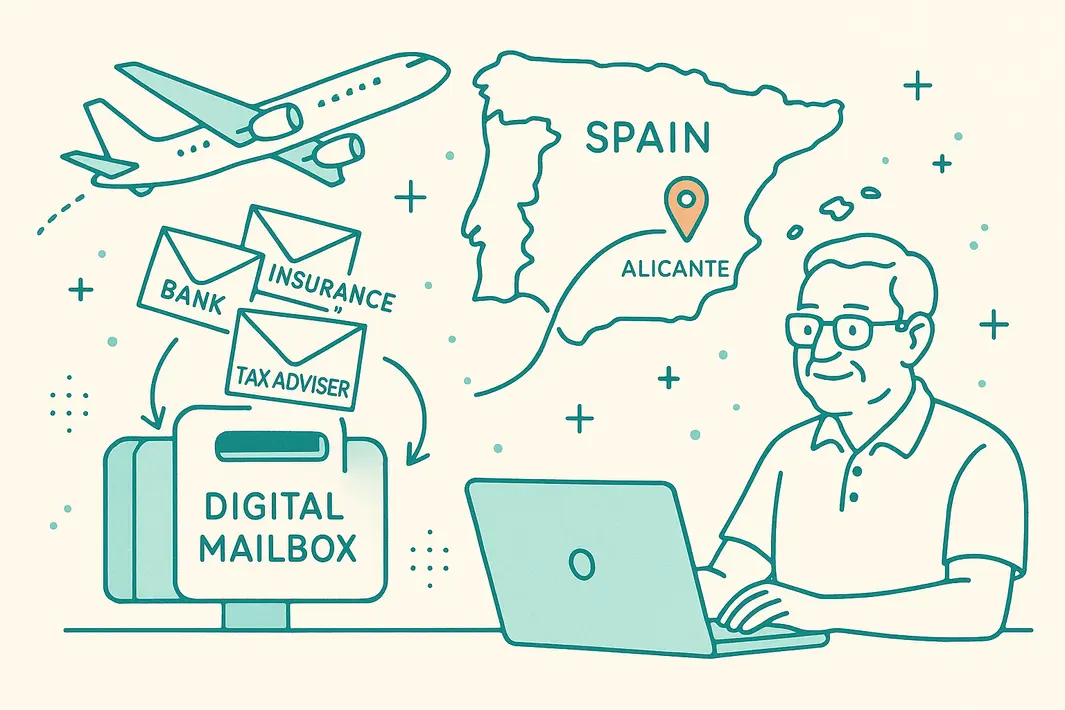
A stable correspondence address in Spain without renting an apartment
A digital PO Box gives you a real correspondence address in Spain without needing to rent an apartment. If you need a Spanish address for your bank, your insurer, your tax adviser or other institutional correspondence, but don't have a lease yet or you aren't physically in Spain year round, a digital PO Box provides one you can use from anywhere. The Digital PO Box (TDPB) offers this through Partner locations across Spain, with mail received on your behalf and available in an online inbox.
Quick Verdict
Why getting a stable address in Spain without renting is tricky
Spain has multiple parallel address requirements, and most expats hit friction at different points. Banks want a Spanish address before you have a permanent place. Insurers want a Spanish address that matches what the bank has. Tax advisers want a Spanish point of contact for routine correspondence. The Padrón and the NLV consulate's accommodation proof both require an actual residence and sit outside what a correspondence address can do.
What the first three share is a need for an address you can give consistently, that doesn't change every few weeks. What the last two share is a need for a real residence with a formal proof-of-residence document.
What people usually try
Asking a friend or family member if you can use their address. Works socially in the short term. Long-term, your friend may move, sell the property or get nervous about being listed on your banking documents. If institutional records start cross-linking your accounts with their address, it can create administrative entanglements for them.
Using a short-term rental address. Some Spanish banks accept an Airbnb or short-term rental address temporarily. Others ask for a longer commitment. Either way, the address changes every few weeks, and the bank starts asking questions when statements bounce.
Renting an empty apartment just for the address. Effective but expensive. A small Spanish flat rents for several hundred euros a month at minimum, plus utilities, deposit, agency fees and the time spent finding it.
Using a gestor or solicitor's office address. Some Spanish gestores offer their office as a temporary correspondence address while you settle in. Reliable, but it ends when the gestor contract ends, and you cannot use it for everything.
The cleanest path is a real correspondence address you control.
What each system actually requires
This is the per-system breakdown: what proof-of-address documents each Spanish institutional system typically requires, and whether a correspondence address can substitute.
The bank. For non-resident accounts (often what you open first), a real Spanish correspondence address is typically used for statements and verification mail. For resident accounts, the bank usually also wants to see a residency document (NIE, TIE, or residencia), but the statement address can still be a correspondence address. Always verify the specific requirements of the institution you are dealing to be 100% sure.
The NLV (Non-Lucrative Visa). At the consulate, accommodation proof typically takes the form of a rental contract, a notarised document from a property owner, or in some cases a long-term hotel booking. The consulate is checking that you will have somewhere to stay, not where statements should be sent. A correspondence address service does not substitute for this.
The Padrón (municipal register). Requires a real residence, with a rental contract, ownership document or signed permission from the property owner. Not substitutable.
Spanish insurance. A correspondence address can be used with private Spanish insurers for policy documents and verification mail. Public health coverage through the convenio especial is administered by regional health authorities and requires Padrón registration plus residency documentation; a correspondence address does not substitute for this. Always check with the corresponding institution.
Hacienda (tax authority). For routine correspondence with Hacienda or a Spanish tax adviser, a correspondence address can work. Tax-residency determination is a separate matter outside TDPB's scope. Consult a qualified Spanish tax adviser for your specific situation.
The bank, insurer and tax adviser layer is where a real correspondence address fits most cleanly. Padrón, NLV consulate and public health enrollment require a real residence with formal proof-of-residence documentation.
How a TDPB Spanish address works
A TDPB Spanish address is a real Partner location, with mail available online. You sign up before you arrive in Spain (or after, depending on your timeline), pick a Spanish city, and use the address for the bank, the insurer, the tax adviser, your invoices and your website.
TDPB operates Partner locations across multiple Spanish regions, including Catalonia, Madrid, the Valencian Community and Galicia (as of May 2026). See the locations page for current cities. You can hold multiple Spanish addresses under one Digital PO Box number if your situation spans regions.
The address is suitable for:
- Spanish bank correspondence (resident and non-resident accounts, depending on bank policy)
- Spanish insurance correspondence
- Spanish tax adviser communication
- Invoices to Spanish or international clients
- Your business website
The address is not suitable for:
- Padrón registration (requires a real residence)
- NLV consulate accommodation proof (requires a rental contract or similar)
- Any system that explicitly requires a residential address with a formal proof-of-residence document from a landlord or property owner
- Domicilio fiscal (this is the address tax authorities use for legally binding notifications. This can only be done by a regulated fiscal representative who takes on legal responsibility)
A practical scenario
A retiree from the UK plans to relocate to the Costa Blanca but does not yet have a long-term rental. They sign up for a TDPB Spanish address in Alicante before they leave the UK. The address is used to set up a Spanish non-resident bank account remotely with banks that permit remote opening, to register with a private Spanish health insurer, and to give the Spanish tax adviser a working correspondence point. Mail from each surfaces in the online inbox while the retiree is still in the UK.
After arrival, the retiree spends two months in short-term rentals while looking for a long-term flat. The TDPB address stays consistent across this period. The bank, the insurer and the tax adviser do not see the address change every two weeks.
Once a long-term flat is signed, the Padrón is processed at the real address. The TDPB correspondence address continues as the address on file with the bank and insurer, because the retiree splits time between Spain and the UK and prefers correspondence to arrive at a place that is always checked.
What this solves
How it works in practice
Sign up for TDPB. Pick a Spanish city. Use the address for the bank, the insurer, the tax adviser and any other Spanish institution. Mail surfaces in your online inbox.
TDPB Partner locations as of May 2026: Spain, Germany, Switzerland, Belgium, Portugal, France and the United Kingdom; Dubai is offered as a PO Box with a real location reference. Austria and Netherlands are next on the expansion list. Multiple addresses can be held under one Digital PO Box number.
The four pricing dimensions:
Best for: Expats, digital nomads, remote workers, freelancers, second-home owners and privacy-conscious individuals who need a stable Spanish correspondence address for banking, insurance and tax administration without renting an apartment they do not actually need.
Get your Digital PO Box for Spain in minutes
Pick a Spanish city, sign up, and have the correspondence address ready before you contact the bank.
This article describes how a correspondence address can support administrative needs in Spain. It is not legal, tax or immigration advice. Consult a qualified professional for residency, tax or visa questions specific to your situation.