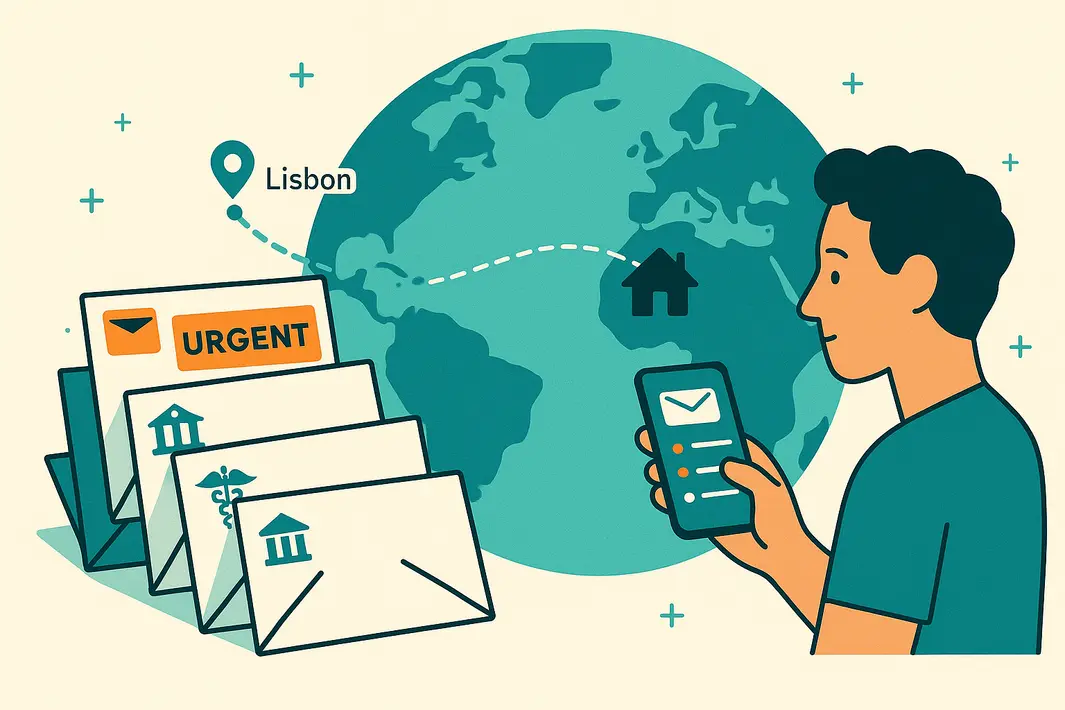
Why 'using your parents' address' stops working for digital nomads
Every digital nomad starts with the same stopgap: use your parents' address. It works for a while. Then it doesn't. Knowing why ahead of time is cheaper than discovering it when your bank flags a statement or your parents call asking what just arrived in the post.
Quick verdict
Why Using Your Parents' Address Works at First
The first time you become a digital nomad, the address question feels small. You give the bank your parents' home address, you tell your friends "use this address for mail," and you fly out.
It works because the address is real, residential and verifiable. Banks accept it. The credit bureau already has it. Subscription services do not blink. From a compliance standpoint, your parents' home is exactly the kind of address institutions expect.
If your nomading is a six-month sabbatical and then you go home, this is fine. The address question never escalates.
Four Failure Modes Over Time
The trouble starts somewhere between year one and year three. The exact trigger varies; the pattern is consistent.
- Your actual life stops matching the address on file
You build a life in Lisbon, Mexico City or Bali. Six months becomes two years. Banks, brokers and government bodies have your parents' US, UK or German address, but you have not lived there in years. If you open a new account, the new institution may cross-check your address against shared databases and ask why the new application does not match where you actually appear to live.Some institutions are lenient. Others are not. The risk is not constant, it's cumulative: each new compliance check, each periodic KYC review and each tax filing builds a record that says one thing while reality says another.
- The mail volume gets uncomfortable
For the first year, your parents receive a few letters a month. Then a credit card mailer arrives. Then a bank statement. Then a tax notice. Then a piece of mail you actually need scanned and forwarded, urgently.Your parents are not your assistant. The arrangement strains. Some weeks they forget. Sometimes the urgent letter sits unscanned for three days because they were out of town. Sometimes a sensitive document gets accidentally thrown out with junk mail.
This is not a personality problem. It is structural. A multi-year, multi-account adult is more administrative load than family arrangements are designed for.
- Your parents change their own situation
They downsize. They move to a retirement community. They sell the family home. They travel for six months themselves. The address you have used for years simply stops being viable.Now you have a problem on a short clock: you need to change your address with dozens of institutions, before the next statement bounces and starts triggering compliance flags. Some banks treat a sudden address change as a risk signal in itself.
- The compliance position becomes harder to defend
Several tax frameworks (CRS, adopted by 120+ jurisdictions, and various national tax-residency rules) increasingly rely on address as a signal. If your parents' address is on file with multiple financial institutions but you have not lived there in years, you may face questions during a periodic review or a tax filing about whether you are correctly identifying your residency. This is not legal or tax advice. Consult a qualified professional for your specific situation.
The address itself is not the crime. The mismatch between the address on file and where you actually live is what creates the issue. Updating the address to a correspondence service you control resolves it: the address is real, you are not claiming to live there for tax purposes, and the financial institution has a working correspondence point that matches your actual setup.
The pattern across nomad communities
This pattern appears verbatim in nomad communities: "I just live with my parents on paper." "I won't have this forever and it really scared me." These are not edge cases; they are the dominant pattern among digital nomads from the US, UK, Canada and most of Europe.
The shared anxiety is about what happens next. Most nomads sense the arrangement has an expiration date, and most do not have a clear next step planned.
What an address you control looks like
A real correspondence address, set up in a stable European country, used as the address on file with banks, brokers, government bodies and platforms. Mail arrives at the address, surfaces in your online inbox, and you handle it from wherever you are.
The address is not your residence. It is the institutional correspondence point. Tax residency is determined separately by where you actually live and the relevant national rules. The address simply tells institutions where to reach you.
TDPB provides this with Partner locations across Europe (as of May 2026), plus Dubai as a PO Box with a real location reference. You pick the location, you sign up, and the address is available immediately. Mail surfaces in your online inbox.
A few practical points:
A practical transition
A nomad has used their parents' address in the UK for three years. Their parents are planning to sell the family home and downsize. The nomad signs up for a TDPB address in the UK (where they are still a UK citizen and have most of their financial accounts), updates each bank, broker and account to the new address. The mail starts surfacing in the online inbox. The parents are released from the role.
A year later, the nomad relocates permanently to Portugal and adds a TDPB Portugal address. Both addresses sit under one Digital PO Box number. The UK address stays in place for UK accounts; the Portugal address handles Portuguese institutions.
How It Works in Practice
Sign up for TDPB. Pick a location in a country where you have administrative ties or where your primary accounts sit. Update each account to the new address. Mail surfaces in the online inbox.
TDPB Partner locations (as of May 2026): Spain, Germany, Switzerland, Belgium, Portugal, France, the United Kingdom, plus Dubai as a PO Box with a real location reference. Austria and Netherlands are next on the expansion list. Multiple addresses can be held under one Digital PO Box number.
The four pricing dimensions:
The address can be used on banks, brokers, insurers, government bodies, your website, invoices and any institution that needs a correspondence point.
Best for: Digital nomads, expats, remote workers, freelancers, second-home owners and privacy-conscious individuals who have outgrown using their parents' or a family member's address as their default correspondence point.
Get your Digital PO Box in a minute and stop relying on your parents
Pick a location, sign up, and update your accounts on your timeline.