
What's different in Spain
Spain has its own vocabulary for addresses, and the differences carry real weight. The same street address can play very different roles: everyday post from your bank, a formal notification from the tax authority, or your registered place of residence. A TDPB address fits one of those roles cleanly, and knowing which one saves you trouble later.
How to write your Spanish address
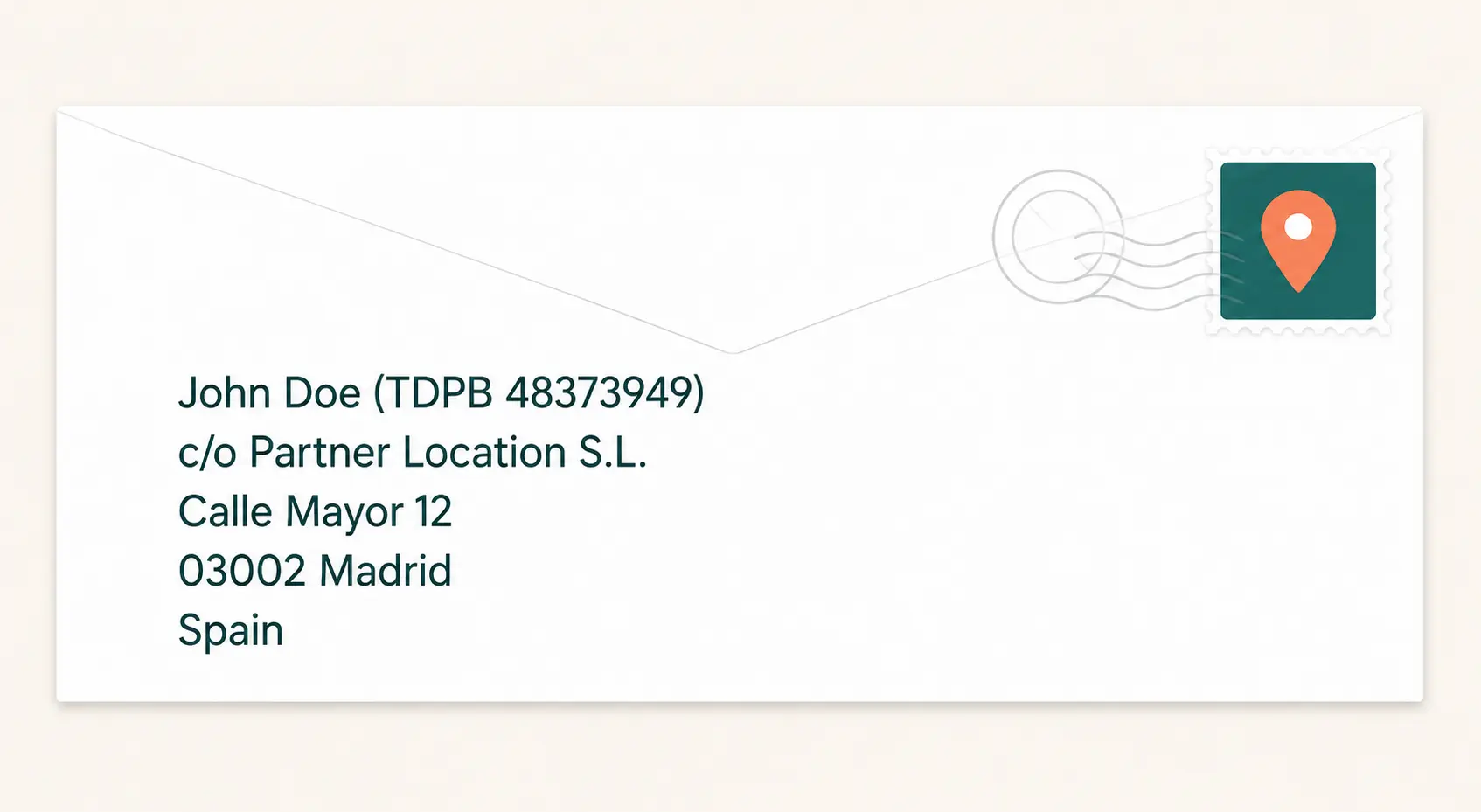
When you receive your Spanish address, use it exactly as we provide it, including the c/o line with your Partner's name. Postal delivery in Spain is less strict than in Germany, where mail isn't delivered if the name on the envelope doesn't match the name on the mailbox. Even so, to rule out any risk of non-delivery, we recommend always keeping the c/o reference in place. It tells the carrier the mail belongs at that location, even though the name on it is yours. A small detail that keeps your post arriving reliably.
Where you can use your address in Spain
Banks and financial institutions
Many customers use their TDPB address with Spanish and international banks for statements, cards and account correspondence. Because each address is a real Partner location used by a limited number of people, not a mass virtual-office hub, it's set up to avoid the patterns banks tend to flag. Acceptance is always the bank's own call, but the model is deliberately built to stand up to it.
Your NIE, taxes and the Spanish authorities
This is where Spain's address vocabulary matters most. There are three distinct roles, and a TDPB address fills only one of them:
In short: a TDPB address handles your private and administrative post in Spain. It doesn't replace a formal notifications address or a tax address, and keeping those separate is exactly what keeps it flexible.

Registering a company or registered office
A TDPB address is a correspondence address, not a registered office (domicilio social) or company seat, so it can't be used to register a company with the Registro Mercantil. If you run a business, you can still use the address for your invoices, website and general business post. It simply isn't the legal seat of the company. For that you'd use a dedicated company-registration provider, and a TDPB address works well alongside it.
Residence and the padrón
Registering on the padrón municipal (empadronamiento) at your town hall requires proof that you genuinely live at the address. A TDPB address is a correspondence address, not a residential one, so it can't be used for empadronamiento or anything else that requires proof of residence. For that, you need the address where you actually live.
Invoices, website and email signature
Yes, and it's one of the most common uses. A TDPB address gives your business a professional Spanish postal address without putting your home address on every invoice and web page. Just keep in mind it's a correspondence address, not a legal business-registration address.
What a TDPB address is, and isn't
To keep expectations clear: a TDPB address is a stable correspondence address. It is not a residential address, not a tax or fiscal address, not a registered office or legal seat, and not a walk-in business location. That narrower scope is deliberate. It's what lets the address stay usable almost everywhere while everything else around you changes. For the full picture of how our addresses work and why, see our main using your address page.
About acceptance
Whether any specific bank, authority or institution accepts any specific address is always their decision. Rules differ by country and situation, and they can change over time. We don't promise acceptance, because we don't control it. What we do control is how the model is built: real Partner locations, used by a limited number of customers, on ISO 27001 and ISO 27701 certified processes, with full transparency about what the address is and isn't.