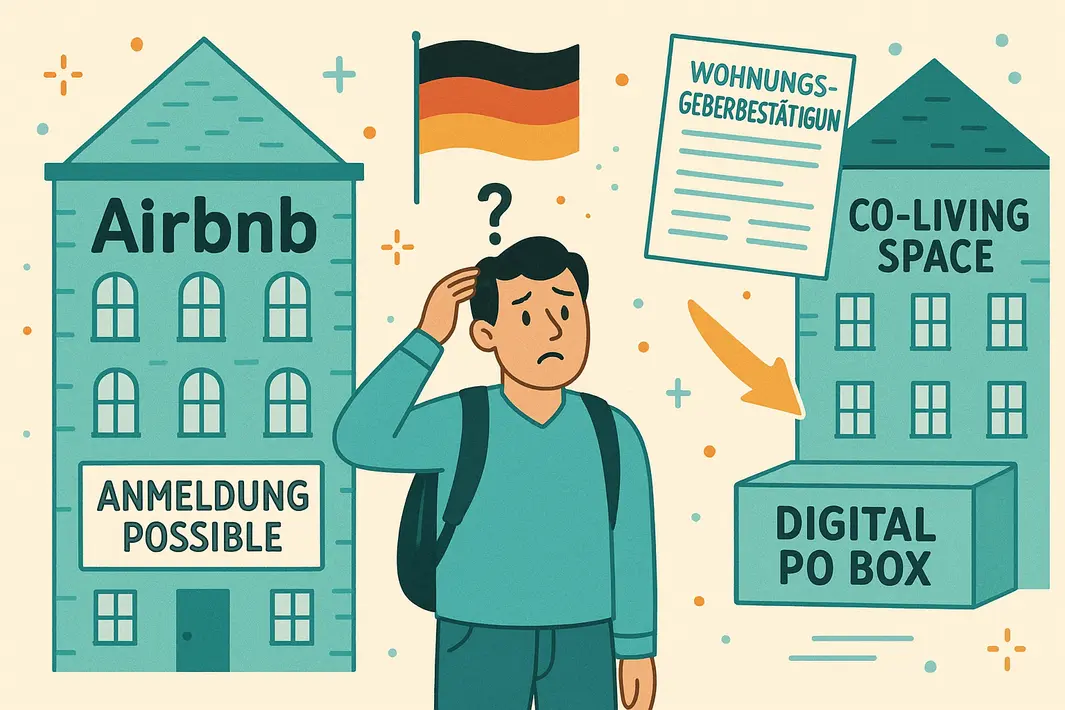
Anmeldung without a permanent apartment in Germany
You moved to Germany or are planning to. Anmeldung within 14 days, the Bürgeramt says. But every flat you can afford wants you to already have an Anmeldung, and every Anmeldung needs an address. The catch-22 has caught a generation of expats.
Quick verdict
What Anmeldung Actually Requires
Anmeldung is the legal registration of your residence with the local Bürgeramt (sometimes called Bürgerservice or Einwohnermeldeamt). It is required for anyone living in Germany for more than three months and triggers your tax ID (Steueridentifikationsnummer), unlocks bank account opening, residence permits, health insurance enrolment, mobile phone contracts and most other administrative steps.
Two things make Anmeldung work:
A real residence. The address you register must be a place where you actually live. The Bundesmeldegesetz (BMG) defines a Wohnung as a place used for living, not just for receiving mail. A correspondence address, a coworking space, a virtual office, a Partner location for a mail service: none of these is a Wohnung in the legal sense.
A Wohnungsgeberbestätigung. This is a signed confirmation from the landlord (or apartment provider) declaring that you live at the address. The Bürgeramt requires it in original or signed PDF form at registration. The provider of the Wohnungsgeberbestätigung is legally on the hook for confirming you actually live there.
A correspondence address service does not provide a Wohnungsgeberbestätigung. We would be signing a legal document declaring you live at our Partner location, which would be untrue. This is why a correspondence address (including TDPB) cannot be used to do an Anmeldung.

Anmeldung without apartment Germany: what's actually possible
Several legitimate paths exist for getting an Anmeldung without a permanent rental apartment.
Long-term Airbnb or temporary rental that explicitly offers Anmeldung. Some Airbnb hosts, serviced apartment providers and Wohnung auf Zeit landlords will provide a Wohnungsgeberbestätigung if your stay is long enough (often 2 to 3 months minimum). Listings increasingly advertise "Anmeldung possible" as a feature. Verify in writing before booking.
Co-living spaces. Several co-living operators in Berlin, Munich, Hamburg, Frankfurt and Köln (Habyt, The Base, Quarters, Wunderflats and others) provide Anmeldung-compatible registration as part of the contract. Pricing is higher than standard rentals but the Anmeldung is built in.
University dormitory or Studentenwerk housing. For students, the Studentenwerk address is typically Anmeldung-eligible.
Friends or family with property in Germany. Legally possible if you actually live there and the property owner signs the Wohnungsgeberbestätigung. The owner needs to be willing and to understand they are confirming you live at the address.
Hostel or hotel for long stays. Some hotels and aparthotels with long-stay rates will provide Wohnungsgeberbestätigung. Less common, but exists in larger cities.
Specialised Anmeldungsadresse services. Some operators in Berlin and Munich advertise "Anmeldungsadresse only" arrangements where a small room is rented specifically for registration. The legal standing of these arrangements is uncertain. The Bürgeramt has been clamping down on fictitious registrations since 2017, and addresses known to host large numbers of Anmeldungen have been flagged in the past. TDPB is not one of these services. Anyone considering this route should take qualified legal advice first; this is not legal advice.
The common thread: each of these provides a real place where you can plausibly be said to live, and a landlord willing to sign the Wohnungsgeberbestätigung. Without those two pieces, Anmeldung does not happen.
Where TDPB fits in
TDPB is a correspondence address, not a residence. It does not provide a Wohnungsgeberbestätigung. It cannot be used to complete an Anmeldung.
What TDPB does solve, in a German context:
After you have an Anmeldung, but you don't always live there. Many expats with Anmeldung in one German city actually spend long stretches abroad. The Anmeldung is legitimate (you live there when you are in Germany), but your mail piles up while you are away. A TDPB German address used as the correspondence address with your bank, insurer, tax adviser and other German institutions surfaces this mail in your online inbox wherever you are.
After de-registration, when you still have open German files. If you de-register (Abmeldung) and leave Germany, German banks, insurers, the Finanzamt, the Krankenkasse and others still need a correspondence address. A TDPB German address fills this gap and keeps the wind-down of your German affairs visible.
For cross-border professionals with German clients or German entities. Freelancers and small business owners who do work for German clients but live elsewhere often need a German correspondence address for invoices, contracts and tax filings. A TDPB German address handles this without claiming residence.
For privacy: separating your registered home address from your business correspondence. Once you have Anmeldung at a residential address, you can still use a TDPB German address for invoices, your website and platform accounts, keeping your home address out of public records.
Across all of these, the principle is consistent: TDPB sits next to your Anmeldung, not in place of it.
How a German TDPB address works in practice
TDPB operates multiple Partner locations in Germany and other countries like Spain, Switzerland, France and the UK, with Austria and Netherlands next on the expansion list. One Digital PO Box number covers addresses across multiple locations and countries from a single account and inbox, which is useful if you have ties to more than one German city, or if you bank in Germany and another European country.
Sign up. Pick a German city. Update your German bank, insurer, tax adviser and any other German correspondence to the new address. Mail starts arriving in your online inbox. You handle it from wherever you are.
The address can be used on your invoices, on your website, and in correspondence with most banks, insurers and government bodies. Always verify the specific requirements of the institution you are dealing with. It is suitable for the correspondence layer; it is not suitable for Anmeldung registration.
The four pricing dimensions:
Best for: Expats, digital nomads, remote workers, freelancers, second-home owners and privacy-conscious individuals who already have or do not currently need an Anmeldung, but who need a stable German correspondence address for banking, tax and business correspondence with German institutions.
Pick a German correspondence address that sits next to your Anmeldung
Sign up for a TDPB German address. Use it on your bank, insurer, tax adviser, invoices and website. Keep your Anmeldung at your actual residence.