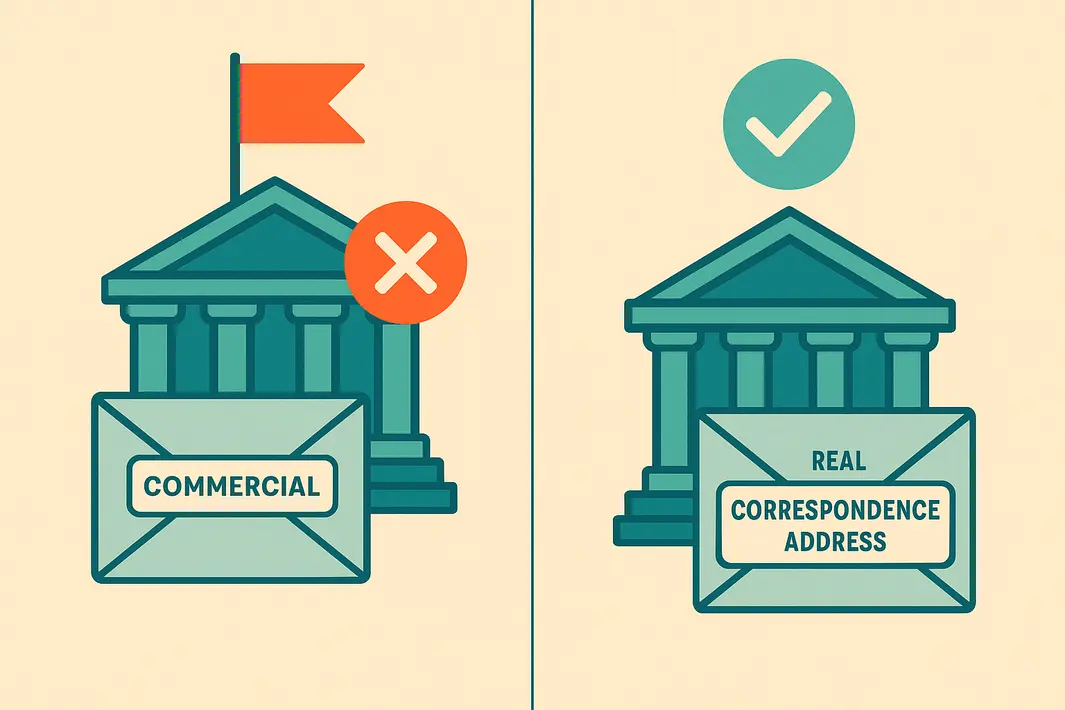
Why your virtual mailbox is getting flagged as commercial (and what an address-first service does differently)
You opened a bank account using your virtual mailbox address. Six months later, the bank flagged it: your application stalls, or you are asked for documentation you cannot easily provide. You did not change anything, but the address itself was the problem.
Quick verdict
Most virtual mailbox services share one structural problem: the address is registered as a commercial mail-receiving point, not a private address. Banks, insurers, and tax offices run automated address checks, and these addresses get flagged.
Side-by-side comparison
| Feature | Standard virtual mailbox | TDPB (address-first) |
|---|---|---|
| Address type | Commercial mail-handling location, often flagged | Real street address at a directly managed local Partner location |
| Network size (as of May 2026) | 2,500 to 4,250+ locations, mostly US-based | Partner locations in Spain, Germany, Switzerland, Portugal, France, the UK, and Belgium, plus Dubai (as of May 2026) |
| Quality consistency | Varies by independent operator | Consistent; Partners managed directly by TDPB |
| Bank and insurer acceptance | Frequently rejected or flagged | Accepted as a correspondence address by most banks, insurers, and government bodies. Always verify with your specific institution. |
| Pricing | European plans typically EUR 20–25/month as a representative average (as of May 2026, verify current rates at each provider's website) | from € 7,50/month on the yearly plan, or € 15/month on the monthly plan, transparent tiers |
| Privacy certifications (as of May 2026) | None publicly disclosed | ISO 27001 + ISO 27701 certified |
| Parcel handling | Yes (FedEx, UPS, DHL) | No. TDPB handles official correspondence only, letters, documents, and formal post. For parcels, use a separate dedicated service. |
| Multiple addresses | Separate plans per location | One Digital PO Box number across multiple cities and countries, one inbox |
| Legal business registration | Sometimes, varies by jurisdiction | No. TDPB is a stable correspondence address for banks, insurers, government correspondence, your website, and invoices. For a registered company seat, use a dedicated business-registration provider. |
| Best for | US package forwarding, US LLC administration | Expats, digital nomads, remote workers, second-home owners, freelancers, and privacy-conscious users needing a stable European / UAE correspondence address |
Why "non-flagged location" claims do not hold up
Some virtual mailbox providers market certain locations as residential-friendly or not yet flagged in address-verification systems. The reasoning is that those specific addresses have not yet appeared in the commercial classification databases used by European banks and insurers.
The problem is structural fragility. As soon as mail volume at that location grows, or as soon as address-verification databases are updated to include it, or as soon as banks expand their database cross-referencing, the position stops holding. You then have to switch addresses and update every institution that has the old one on file. The administrative cost of an address change across banks, insurers, tax offices, and registries is significant, and you only learn that the change is needed after something has already gone wrong.
A correspondence address built from the ground up to function as a real address, at a directly managed Partner location specifically selected for this purpose, avoids this failure mode entirely.
Why virtual mailboxes get flagged
Locations handling mail for hundreds or thousands of customers are registered as commercial mail-receiving points in postal and address-verification databases. Banks check these automatically, both at account opening and during periodic compliance reviews.
In Europe, banks in Spain, Germany, the Netherlands, and other markets run their own address checks against commercial databases and credit-reference agencies (SCHUFA in Germany, ASNEF in Spain, and equivalents elsewhere). A location that handles high mail volumes for many separate businesses gets classified as commercial in those systems. When your address shows up as commercial, it triggers different verification thresholds.
The US picture is similar but more codified: the USPS labels these addresses as Commercial Mail Receiving Agencies (CMRA), and many US banks now block CMRA addresses outright. The classification was introduced to combat fraud and money laundering, and banks default to caution.
Real-world examples that reflect what people report:
The common thread is that nothing about the user has changed. The address itself signals a category that triggers institutional caution.
Where standard virtual mailboxes have the edge
For some use cases, the marketplace model genuinely works better:
Where TDPB is the stronger fit
For European correspondence and address-first use cases, TDPB is built differently:
Final verdict
| Need | Best option |
|---|---|
| US banking and US LLC administration | Standard virtual mailbox (non-CMRA where possible, with the caveats above) |
| Stable European correspondence address | TDPB |
| Remote workers and freelancers needing an address for banking, invoicing, and their website | TDPB |
| Privacy-conscious users | TDPB |
| Both US and European presence | Combine both. They are not mutually exclusive. |
Get a real correspondence address
TDPB provides a real street address at a directly managed Partner location for your bank, insurer, government correspondence, website, and invoices.