





Table of contents
Latest articles

Virtual Mailbox for Your Second Home: How to Choose
Posted on November 24, 2026

Should You Use Your Home Address for Your Business?
Posted on November 24, 2026

Virtual Address vs Mail Scanning Service: Which Do You Need?
Posted on November 12, 2026

How to Choose a Virtual Address in Europe (2026)
Posted on October 27, 2026

Do Freelancers Actually Need a Business Address?
Posted on October 12, 2026

Best Digital Address Services in Europe (2026)
Posted on August 18, 2026

What is a virtual address and how does it work
Posted on August 18, 2026
Is a Digital Address Secure? Our ISO Certification, Explained
Posted on August 17, 2026

EU Digital Services Act
Posted on July 13, 2026

PO Box Alternatives in Dubai for Expats (2026)
Posted on March 3, 2026
Virtual Address vs Mail Scanning Service: Which Do You Need?
You need an address that doesn't change every time you move. Then you start looking, and you keep running into two things: a virtual address and a mail scanning service, sometimes sold together, sometimes apart. If hardly any post comes your way, you start to wonder whether you're about to pay every month for something you'll barely use.
A virtual address is the address itself: a real place to give your bank, your insurer and the authorities, which stays the same when you move. A mail scanning service is what happens to post after it arrives at that address: someone opens it, scans it and puts it online for you. You need the address every month, because it does its job by being on file with everyone who might write to you, whether or not any post arrives. How much scanning you need depends on how much post you get.
At The Digital PO Box, your address is a real street address at one of our local Partners: an established business, such as a coworking space or a copy shop, that receives post on your behalf. We build on 15+ years of experience managing reliable address and mail infrastructure. Most of our customers receive little or no post, so we charge for the address and for scanning separately. On the annual plan, the address works out to € 7,50 a month. If you pay per scan, you pay only for the letters that actually arrive.

Virtual address vs mail scanning service at a glance
A virtual address and a mail scanning service do different jobs, and you pay for them in different ways.
| Virtual address | Mail scanning service | |
|---|---|---|
| What it is | A real address you give out for correspondence | A service that opens your post, scans it and shows it to you online |
| What it does in a month with no post | Keeps you reachable, because the address is on file with everyone who might write to you | Nothing, because there is nothing to scan |
| How you usually pay | A fixed fee per address, monthly or yearly | Per scan, or a monthly fee for unlimited scans |
| Can you have it on its own? | Yes, when the provider charges for it separately | No, because post needs an address to arrive at first |
What is a virtual address used for?
A virtual address is used for correspondence: it's the address you give anyone who needs to reach you by post. That includes:
- banks and insurers
- government offices in your home country that send pension, healthcare and tax letters
- subscriptions and online sign-ups
- your invoices, website and email signature
- now and then, a friend or relative sending you a card
The address can also keep your home address private. Many people already keep a work phone number separate from their private one, and a second postal address does the same for post. You give it out instead of your home address, so people can reach you by post without knowing where you live. We explain why that matters in why your address matters more than your mail.
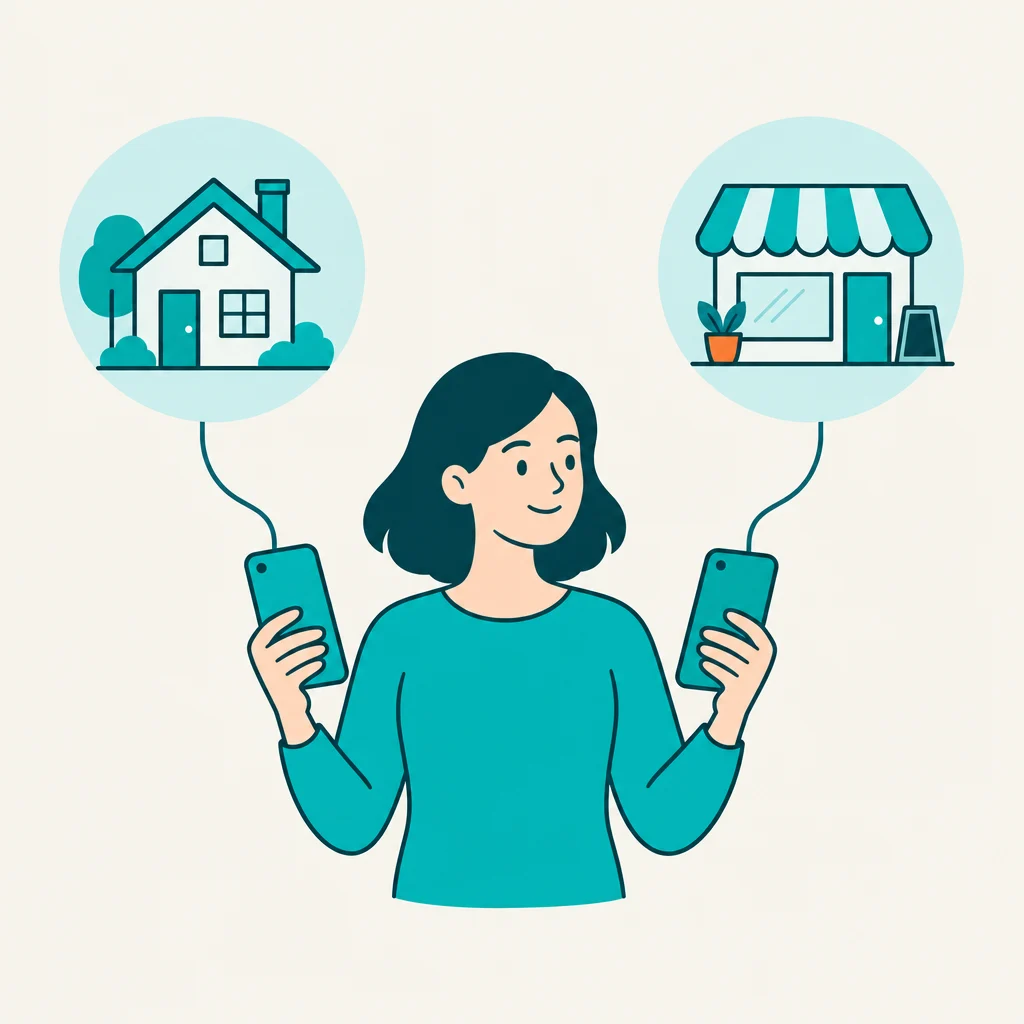
You choose where your address is from our active locations, and you can hold addresses in more than one country. Each address includes your personal TDPB number, a reference number unique to you at The Digital PO Box. Because the same TDPB number is part of all your addresses, post sent to any of them reaches you in the same online account. In Dubai, the address is a PO Box with a location reference rather than a street address. For how an address like this is set up, see what a virtual address is and how it works.
What does a mail scanning service do?
A mail scanning service turns paper post into something you can read on your phone or computer. When a letter arrives at your address, the people there open it, scan the contents and upload the scan to your online account, and you get a notification. What happens to the paper original after that depends on the service and on what you choose: it can be shredded, or posted on to you.
What does each cost in a month when no post arrives?
With us, a month with no post costs you the address fee and nothing else, because the address and scanning are charged separately. The annual plan is € 90 a year, which works out to € 7,50 a month. If you prefer to pay monthly, the address is € 15 a month.
When letters arrive, you pay for scanning in one of two ways:
- Scan credits. You buy credits in bundles and use one credit per scan. The smallest bundle is 10 scans for €12.50, which is €1.25 a scan, and larger bundles bring the price down to €0.90 a scan. Credits stay valid for 12 months while your subscription is active, and you can use them at any of your addresses.
- Unlimited. €7.50 a month per address, billed monthly, for as many scans as you need at that address. A fair use policy applies.
| Your month | What you pay |
|---|---|
| A few letters a month | The address fee, plus one scan credit per scan |
| More than about six to eight scans a month at one address | The address fee, plus Unlimited at €7.50 a month for that address. Six to eight credits cost about €7.50, so above that, Unlimited costs less. |
| A paper original posted to you | The shipping cost, which we charge per shipment based on weight and destination. Neither scanning option includes it. |
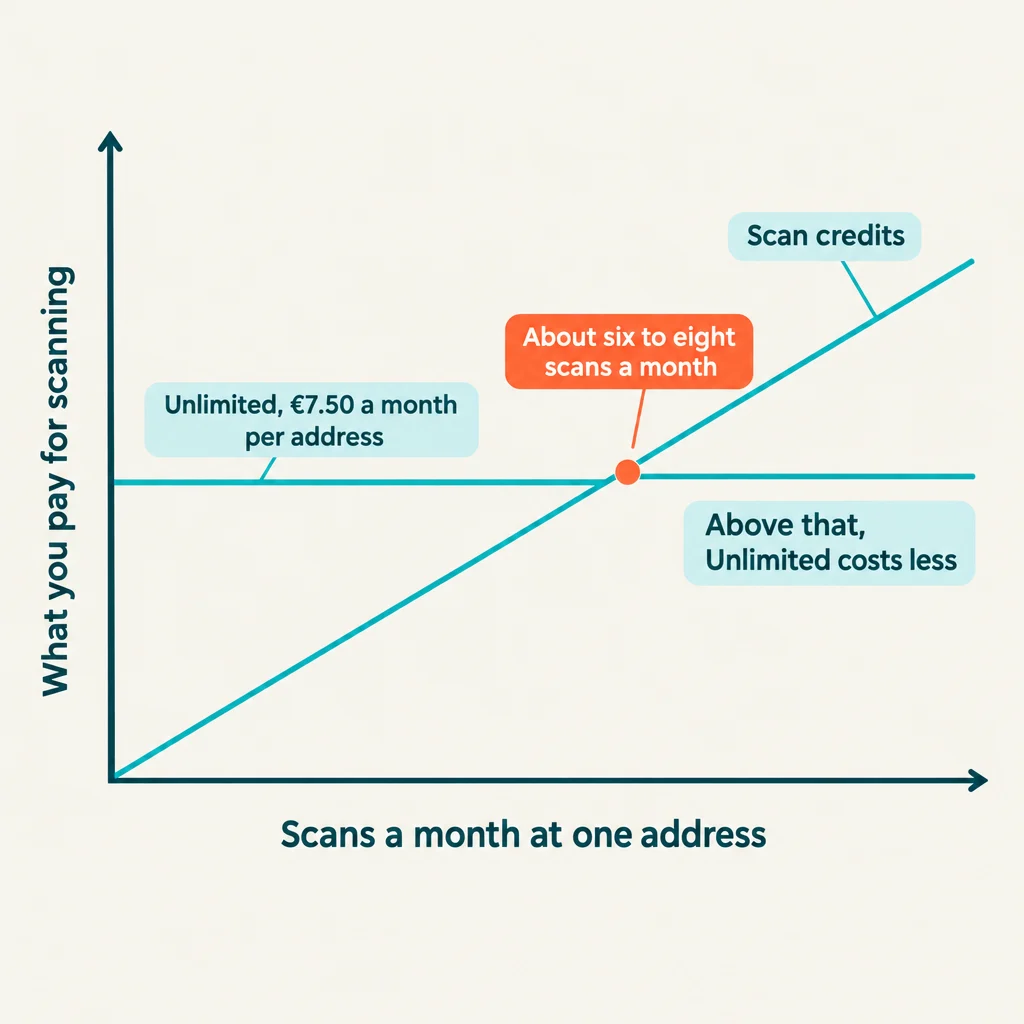
All prices exclude VAT. You'll find every figure on our rates page.
Which one do I need?
Most people need the virtual address, and add scanning for the occasional letter that arrives. How much scanning depends on your situation:
- You move often, as many digital nomads and remote workers do. Without an address that stays put, every move means updating your bank, your insurer and everyone else who writes to you. Scan credits cover the occasional letter.
- You own a second home. Letters about that home arrive while you're somewhere else. Give the address to the organisations that write to you about the home. When one of their letters arrives, it's scanned with a scan credit, so you can read it wherever you are. Some second-home owners ask a neighbour to collect their post and pass it on instead, and our comparison of digital post and mail forwarding covers that and postal redirects.
- You've moved abroad but still get official post from home, as many expats do. Without an address of your own, that post tends to land at a relative's house. Give the address to the pension, healthcare and tax offices that write to you, and use scan credits to read their letters.
- You want fewer letters at home and your home address kept private. One person on a UK money forum put it simply: "Just trying to reduce the volume of letters coming to home address." Here you give out the address instead of your home address, and you may need very little scanning, or none.
When is a scan-first service the better choice?
A scan-first service is the better choice when post arrives every week and you need to read nearly all of it. Some businesses still receive invoices, contracts and client letters on paper, and for them scanning is the main job. Services built around scanning large amounts of post are designed for that.
We built The Digital PO Box for people whose main need is an address that stays the same, with occasional post to deal with. If your main need is scanning a lot of post, a scan-first service will serve you better. Our overview of digital address services in Europe explains the different kinds of service.
Who opens my post, and when?
At The Digital PO Box, a letter is opened only when your mail setting is scan and destroy or scan and forward. You choose that setting up front in your account, and it applies to all your incoming post rather than letter by letter. You can change it at any time, and the new setting then applies to all your post. There are three options:
- Scan and destroy. The letter is opened and its contents scanned, and the original is shredded after 14 days.
- Scan and forward. The letter is opened and its contents scanned. The original is kept at your address and posted to you with any others every two weeks or monthly, as you choose.
- Forward unopened. Only the envelope is scanned, and the letter is posted to you sealed. This still uses a scan credit, because the envelope is scanned.
When a letter arrives, the local Partner at your address receives it and handles it according to your setting, and you get a push notification. Post is usually processed within 24 hours of delivery, so if a letter arrives on a Tuesday afternoon, you typically know about it by Wednesday. Advertising mail, such as brochures and catalogues, is destroyed or returned to sender rather than scanned. Our mail processing page walks through each option.
Scanning is automated, and the Partner who handles your letters never reads their content. Only you can see your scans, in your online account. Our company and platform are certified to ISO 27001 for information security and ISO 27701 for privacy, which means independent auditors regularly check that your data and your privacy are protected. We explain what that involves in our ISO certification, explained.
Do banks and authorities accept a virtual address?
Whether a bank, insurer or authority accepts an address is always their decision, so check with each one you plan to use it with. Our addresses are at real local businesses rather than large mail centres, and each one is used by a limited number of customers. Addresses shared by many customers at large mail centres are the kind banks and authorities most often flag, and we set up our network this way to avoid that. Acceptance still depends on the institution, the country and your situation.
Can I use it as a registered office or for company registration?
The Digital PO Box address can't be used as a registered office, because it's a correspondence address.
You can use it for:
- correspondence with banks, insurers and authorities
- business correspondence, such as on your invoices and website
You can't use it for:
- a registered office or company seat
- company formation or tax registration
- proof of where you live
What business use is allowed depends on the country. In the UK, for example, you can use the address for business as a sole trader, but not for a limited company. Our Using your address page sets out what the address can be used for. It also links to our country guides, so you can check whether there's a guide with the rules for your country.
What about parcels?
Parcels need a separate service, because our address is for letters and documents. If you also receive parcels, use a parcel-forwarding service for them alongside your address. Companies built around parcels are rarely set up to handle post well, and companies built around post rarely handle parcels well. Two services, each doing its own job, work better than one trying to do both.
See how TDPB works for you
Once you know whether you need the address, scanning or both, three things are worth checking in any provider:
- Permitted use, written down. You will give this address to your bank, your insurer and the authorities, so you need to know exactly what it may be used for. A provider that stays vague about this is leaving the risk with you.
- How many people share the address. Banks and authorities recognise the pattern of a mail centre with thousands of customers behind one door, and they look harder at post going there.
- What is bundled into the price. If mail handling is baked into the monthly fee, you pay for scanning whether or not anything arrives.
Our own model answers all three. Every TDPB address sits at an independent local business, where handling post is one part of the business, not the reason the location exists. Each address serves a limited number of customers.
Our platform is voluntarily certified to ISO 27001 and ISO 27701. The setup is designed to avoid the patterns banks and authorities most often flag, though acceptance is always the institution's decision. An address costs from € 7,50 per month (billed yearly), or € 15 per month for more flexibility, with mail handling charged separately.
See our trusted Partner network for how that works in practice, and the location selector page for where we are live.
Try it and see how it feels to stay private and reachable
You don’t need to give up your personal space to stay connected. Full control from your phone or laptop.
A few common questions
You can cancel the address subscription at any time, and there's no long-term contract. If you paid for a year, your address stays active until the end of that year, and the annual payment isn't refunded.
You can switch between scan credits and Unlimited at any time. Credits you've already bought aren't refunded, but you can keep using them while they're valid.
A mail scanning service and a virtual mailbox usually mean the same thing: a service that receives post at an address, then scans it and forwards it on request. A virtual address is the address on its own, without the scanning.


